

Most investors only pay attention when the RBI changes interest rates. The real story, however, often lies in what the RBI says when it does nothing at all.
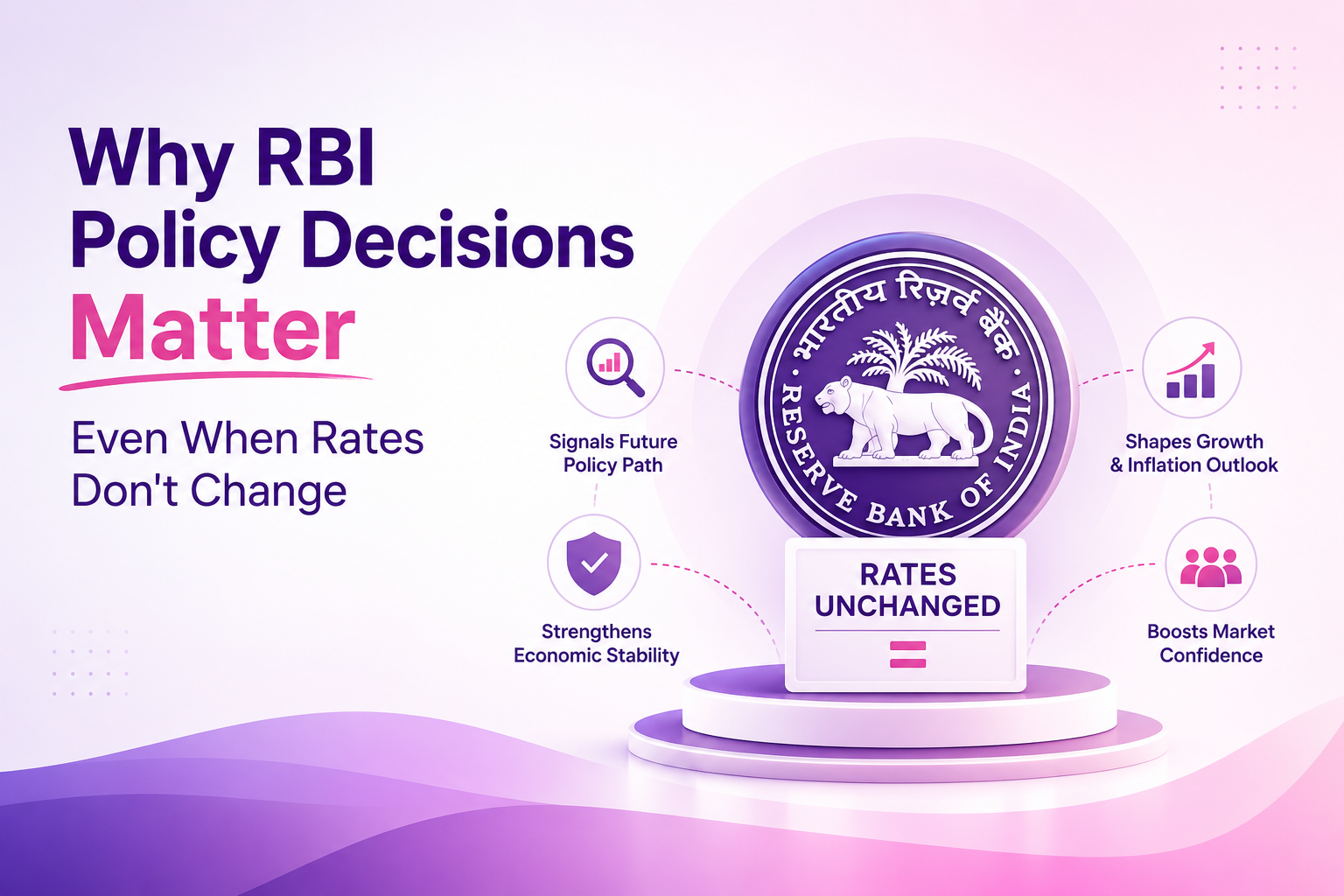
A Quiet RBI Policy Can Move Markets More Than a Rate Hike
Imagine this. The RBI announces its Monetary Policy Committee (MPC) decision.The headlines read:
“Repo Rate Unchanged.”
Most investors assume nothing happened.
No rate cut.
No rate hike.
No big news.
Yet within hours, bank stocks move, bond yields react, the rupee fluctuates, and analysts revise forecasts.
Why?
Because monetary policy is far more than a single number.
In reality, the repo rate is only one part of the message. The RBI’s growth outlook, inflation forecasts, liquidity stance, commentary on global risks, and future guidance often matter more than the rate decision itself.
For investors, understanding these signals can provide valuable insight into where the economy and markets may be headed next.
What Exactly Is the RBI Trying to Do?
The RBI has a dual challenge:
- Keep inflation under control.
- Support economic growth.
Its official inflation target is 4%, with a tolerance band of 2% to 6%. This sounds simple.
In practice, it is a constant balancing act. If inflation rises too quickly:
- borrowing becomes expensive
- purchasing power falls
- household budgets get squeezed
If growth slows:
- businesses invest less
- jobs become harder to create
- economic activity weakens
Every RBI policy decision is essentially an attempt to balance these competing forces.
Why “No Change” Is Often a Policy Decision
Investors often focus exclusively on the repo rate. But maintaining rates can itself be a strong signal. When the RBI keeps rates unchanged, it may be communicating:
- inflation risks remain elevated
- growth is healthy enough
- global uncertainties require caution
- previous rate changes are still working through the system
The rate may not move. But the message often does.
The Four Signals Smart Investors Watch
1. Inflation Forecasts
Inflation forecasts often matter more than current inflation data.
Why?
Because markets are forward-looking. If inflation is expected to remain under control, future rate cuts become more likely. If inflation expectations rise, future tightening becomes more likely. Investors should therefore pay close attention not just to today’s inflation number but to what the RBI expects six to twelve months ahead.
2. GDP Growth Outlook
The RBI’s growth projections provide insight into how policymakers view the economy. For investors, growth forecasts affect:
- corporate earnings expectations
- sector performance
- credit growth
- equity market sentiment
If growth expectations improve:
- banks often benefit
- industrial companies gain confidence
- cyclical sectors perform better
If growth expectations weaken:
- defensive sectors become more attractive
- investors may seek stability
3. Policy Stance
This is one of the most overlooked parts of every RBI announcement. The stance tells investors how the RBI is thinking. Generally, policy stances fall into three categories:
Accommodative
The RBI is focused on supporting growth.
Neutral
The RBI is keeping its options open.
Hawkish
The RBI is more concerned about inflation.
The stance often tells markets more about the future than the actual rate decision.
4. Liquidity Measures
Most retail investors ignore liquidity. Institutional investors do not. Liquidity determines how much money is flowing through the financial system. Liquidity impacts:
- credit growth
- lending activity
- bond yields
- stock market participation
Many market rallies are driven not only by earnings growth but also by liquidity conditions.
Why Bond Markets Listen More Carefully Than Equity Markets
When the RBI speaks, bond markets react first. That’s because bond prices are highly sensitive to:
- inflation expectations
- interest rates
- liquidity conditions
- fiscal stability
A change in RBI language can sometimes move government bond yields even when rates remain unchanged. And since bond yields influence:
- corporate borrowing costs
- home loans
- business investments
- valuations
the impact eventually flows into equities as well. This is one reason why institutional investors spend so much time analyzing RBI commentary line by line.
What Does This Mean for Mutual Fund Investors?
Different mutual fund categories react differently to RBI policy.
Debt Funds
Often most directly affected. Falling interest rate expectations generally support bond prices and can benefit longer-duration debt funds.
Banking Funds
Policy decisions influence:
- credit growth
- loan demand
- net interest margins
Equity Funds
The effect is indirect but important. Lower inflation, stable growth, and supportive liquidity generally create a favorable environment for equities over the long term. The key takeaway: Investors should not judge an RBI meeting only by whether rates changed. The broader policy narrative matters more.
The Hidden Link Between RBI Decisions and Your Everyday Life
Even if you never buy a bond or track RBI meetings, monetary policy affects you.
It influences:
- home loan EMIs
- car loan rates
- fixed deposit returns
- savings account yields
- business borrowing costs
- job creation
- inflation in everyday expenses
When the RBI signals concern about inflation, it may eventually affect what you pay for groceries. When it signals support for growth, it may influence credit availability across the economy. Monetary policy is not a market-only event. It is a household event.
What Investors Should Do After Every RBI Policy
Instead of asking:
“Did the RBI cut rates?”
Ask:
- What changed in inflation projections?
- What changed in growth projections?
- Did the policy stance change?
- Did liquidity conditions change?
- What risks did the RBI highlight?
These questions often reveal more than the repo rate itself.
Final Thoughts
The biggest mistake investors make is treating RBI policy as a simple rate announcement. In reality, every policy decision is a roadmap for how India’s most important financial institution sees the future. The repo rate may remain unchanged. But inflation forecasts may shift. Growth expectations may change. Liquidity conditions may evolve. Market opportunities may emerge.
For long-term investors, understanding these signals can provide far greater value than reacting to headlines alone. Because successful investing is not about predicting the next RBI move. It’s about understanding what the RBI is telling you about the economy before everyone else notices.
FAQs
Why does the RBI keep interest rates unchanged?
The RBI may keep rates unchanged when it believes current policy settings are appropriate for balancing inflation and economic growth while monitoring future risks.
Why do stock markets react when the RBI doesn’t change rates?
Markets react to the RBI’s commentary, inflation forecasts, growth outlook, liquidity measures, and future policy signals—not just the repo rate.
What is the RBI’s inflation target?
The RBI aims to maintain inflation at 4%, with a tolerance band of 2% to 6%.
How do RBI policy decisions affect mutual fund investors?
Debt funds are directly impacted by interest rate expectations, while equity funds are influenced through economic growth, liquidity, and inflation trends.
Why is the RBI’s policy stance important?
The policy stance helps investors understand whether the RBI is more focused on supporting growth, controlling inflation, or maintaining flexibility for future decisions.
What should investors watch during an RBI policy announcement?
Investors should monitor inflation forecasts, GDP growth projections, policy stance, liquidity measures, and commentary on domestic and global risks.
Moolaah is the brand name of iAltInvest Private Limited, an AMFI-registered Mutual Fund Distributor (ARN-245875). We distribute Regular Plans of Mutual Fund schemes, which involve the payment of trail commission to us. Our services are incidental to product distribution and do not constitute independent investment advice. Mutual Fund investments are subject to market risks, read all scheme related documents carefully.