
A few years ago, investing in India felt distant, technical, and intimidating.
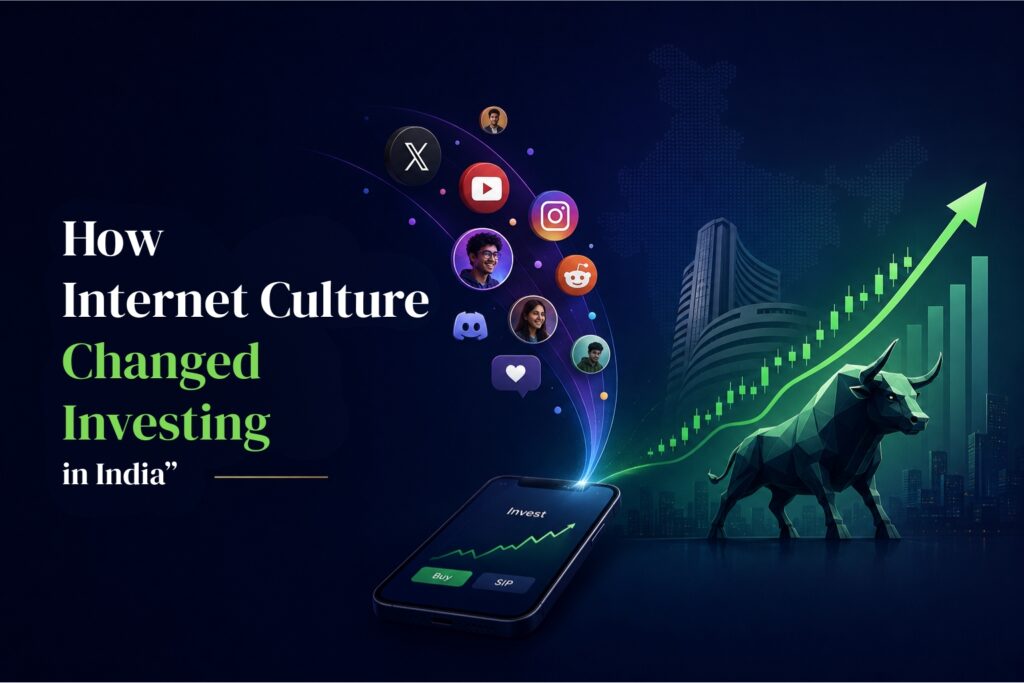
Today, it lives on Instagram Reels, YouTube thumbnails, Telegram groups, Reddit discussions, finance memes, and WhatsApp forwards. Markets are no longer discussed only on business news channels or inside brokerage offices. They are part of internet culture now.
People casually talk about SIPs over coffee.
Friends compare mutual funds on group chats.
Finance creators break down RBI policies using memes.
Market crashes trend on Twitter before they reach television debates.
And perhaps most importantly:
a new generation of Indians has started viewing investing not as a luxury for the wealthy – but as a normal part of adult life.
This cultural shift may quietly become one of the biggest financial transformations India has ever seen.
The Internet Made Finance Feel Accessible
For decades, investing in India had an exclusivity problem. Many people believed markets were: too risky, too complicated, only for experts, only for wealthy individuals. Traditional financial communication also did not help. Advice often sounded overly technical, corporate, or intimidating. Financial jargon created distance instead of confidence.
Then internet-native finance content changed the tone completely. Suddenly, investing was explained using relatable language, visual storytelling, humour, short-form videos, pop culture references and behavioural examples.
Finance stopped sounding like a textbook. And when people understand something emotionally, participation increases. That is exactly what happened in India.
UPI and Fintech Apps Changed Financial Behaviour First
Before people became comfortable investing digitally, they became comfortable handling money digitally.
The rise of UPI fundamentally reshaped financial behaviour in India. Millions of Indians who once relied heavily on cash suddenly became comfortable with:
- QR code payments
- instant transactions
- mobile banking
- digital wallets
- app-based financial services
This matters psychologically. Because once people trust digital money movement, they become more open to digital investing platforms as well.
The leap from:
“sending money online” to “investing money online” became much smaller.
Fintech apps simplified onboarding even further. Opening a demat account or starting an SIP today takes minutes – not weeks. Convenience accelerated participation.
Social Media Turned Investing Into Everyday Conversation
One of the biggest changes internet culture created was visibility. Earlier, investing conversations were private and limited. Now finance exists everywhere online. People consume:
- market updates on Instagram
- investing explainers on YouTube
- macro commentary on LinkedIn
- stock discussions on Reddit
- finance memes on X
- SIP calculators shared on WhatsApp
This constant exposure normalized investing behaviour. When younger audiences repeatedly see conversations around:
- wealth creation
- compounding
- mutual funds
- financial independence
- inflation
they begin seeing investing as socially relevant. The internet transformed finance from a niche activity into mainstream digital culture.
The Rise of the “Finance Creator Economy”
India also witnessed the rise of finance creators and educators who simplified complex topics for mass audiences. Many creators explained:
- SIPs
- budgeting
- stock markets
- inflation
- taxes
- personal finance mistakes
using storytelling rather than textbook language. This changed financial literacy dynamics significantly. People who may never read a finance newspaper now consume financial education daily through short-form content.
Of course, internet finance also comes with problems like misinformation, hype-driven investing, unrealistic return expectations, viral stock tips, fear-based content. But overall, the accessibility of financial education has increased dramatically. And awareness often comes before disciplined investing behaviour.
Investing Became Part of Aspirational Culture
The internet also changed how Indians emotionally view money. Earlier, wealth conversations were often conservative and private. Now financial growth has become aspirational.
Young professionals openly discuss portfolio growth, SIP goals, early retirement, passive income, market investing, FIRE (Financial Independence, Retire Early).
This shift reflects a broader cultural evolution. India’s younger working population increasingly sees investing as empowerment, independence, security, status, self-improvement.
The idea of “money working for you” has entered mainstream ambition. And internet culture accelerated that shift rapidly.
The Pandemic Accelerated Everything
COVID-19 became a major turning point for retail investing behaviour in India.
During lockdowns screen time increased, financial uncertainty rose, digital adoption accelerated, online learning exploded. At the same time, markets experienced dramatic volatility.
Many first-time investors entered markets during this period after consuming finance-related content online. This created a new wave of digitally native investors who learned investing almost entirely through the internet ecosystem.
In many ways, India’s investing boom was not just financial. It was behavioural and technological.
But Internet-Driven Investing Has Risks Too
The internet democratized financial access. But it also accelerated emotional investing. Today, investors are exposed to nonstop market noise, prediction culture, fear cycles, FOMO-driven investing, viral opinions. Short-form content can sometimes oversimplify long-term investing realities. Markets are increasingly reacting not only to fundamentals – but also to sentiment amplification online. This is why financial literacy matters more than ever. Because investing success rarely comes from chasing trends, reacting emotionally, following viral tips.
Long-term wealth creation usually depends on consistency, patience, disciplined behaviour, realistic expectations.
The internet opened the door. But behaviour still determines outcomes.
India Is Becoming a Financially Participative Economy
The most important outcome of internet-driven investing culture is participation.
More Indians are now:
- entering capital markets
- understanding inflation
- learning about wealth creation
- exploring financial planning
- discussing economic policy
This has long-term implications for India’s economy. A financially aware population creates deeper market participation, stronger domestic capital flows, broader wealth creation and greater financial inclusion.
And as financial conversations become more mainstream, platforms focused on clarity, education, and intelligent investing communication will become increasingly important. Because modern finance no longer competes only on products. It competes on understanding.
Final Thoughts
Internet culture did not just change how Indians consume content. It changed how they think about money.
Investing is no longer hidden behind complicated language or institutional walls. It has become part of digital conversation, lifestyle ambition, and modern financial identity.
But with greater access comes greater responsibility.
The future of investing in India will likely belong not to those who consume the most financial content – but to those who develop the best financial behaviour. Because in a world full of market noise, clarity still compounds the fastest.
FAQs
Why are so many young Indians suddenly investing?
Easy access to investing apps, rising financial awareness, inflation concerns, and social media exposure have made investing far more mainstream among younger Indians.
Did social media influence investing culture in India?
Yes. Platforms like YouTube, Instagram, LinkedIn, and X made financial content more accessible, relatable, and conversational for mass audiences.
Why did SIPs become so popular in India?
SIPs simplified investing by making it affordable, automated, and easier for salaried individuals to invest consistently every month.
Has UPI indirectly helped investing grow in India?
Absolutely. UPI increased trust in digital financial systems, making users more comfortable using fintech apps for investing and wealth management.
Are finance influencers changing how Indians invest?
Yes — both positively and negatively. They improved financial awareness significantly, but also contributed to hype-driven and emotional investing in some cases.
Why are more Indians interested in wealth creation today?
Rising living costs, aspiration-driven culture, financial independence goals, and increased internet exposure have made wealth creation a bigger priority for modern Indians.
Moolaah is the brand name of iAltInvest Private Limited, an AMFI-registered Mutual Fund Distributor (ARN-245875). We distribute Regular Plans of Mutual Fund schemes, which involve the payment of trail commission to us. Our services are incidental to product distribution and do not constitute independent investment advice. Mutual Fund investments are subject to market risks, read all scheme related documents carefully.