

Table of contents
- Why verifying a mutual fund distributor is important
- Step 1: Check AMFI registration (ARN)
Use the AMFI distributor verification tool - Step 2: Verify NISM certification validity
- Step 3: Check EUIN for corporate distributors
- Step 4: Assess experience and conduct beyond registration
- Step 5: Reduce effort by using verified platforms
- Common red flags to watch out for
Before investing in mutual funds, one of the most important checks is not about returns or fund performance – it’s about who is guiding you.
A registered and certified mutual fund distributor operates under regulatory oversight, follows defined conduct standards, and is accountable for their actions.
This blog explains how investors can verify whether a mutual fund distributor is registered and certified in India, and why these checks matter before starting any investment journey.
Why verifying a mutual fund distributor is important?
Mutual fund distributors play a role in fund selection, transaction execution, and ongoing portfolio support. If a distributor is unregistered or uncertified, investors may face risks such as mis-selling, lack of accountability, or improper handling of investments.
Verifying registration and certification ensures that the distributor:
- Meets regulatory eligibility standards
- Has cleared mandatory examinations
- Operates under defined codes of conduct
- Can be held accountable under industry rules
Step 1: Check AMFI registration (ARN)
Every individual or corporate mutual fund distributor in India must be registered with the Association of Mutual Funds in India (AMFI).
Once registered, the distributor is issued an AMFI Registration Number (ARN). This ARN confirms that the distributor is authorised to distribute mutual fund schemes and operate within the regulatory framework.
A valid ARN is the most basic requirement. If a distributor cannot share their ARN, or avoids the question, that is a clear red flag.
Use the AMFI distributor verification tool
Investors can independently verify a distributor’s registration and certification status through AMFI’s official database.
Go to the “Locate Your Distributor” section on the AMFI website.
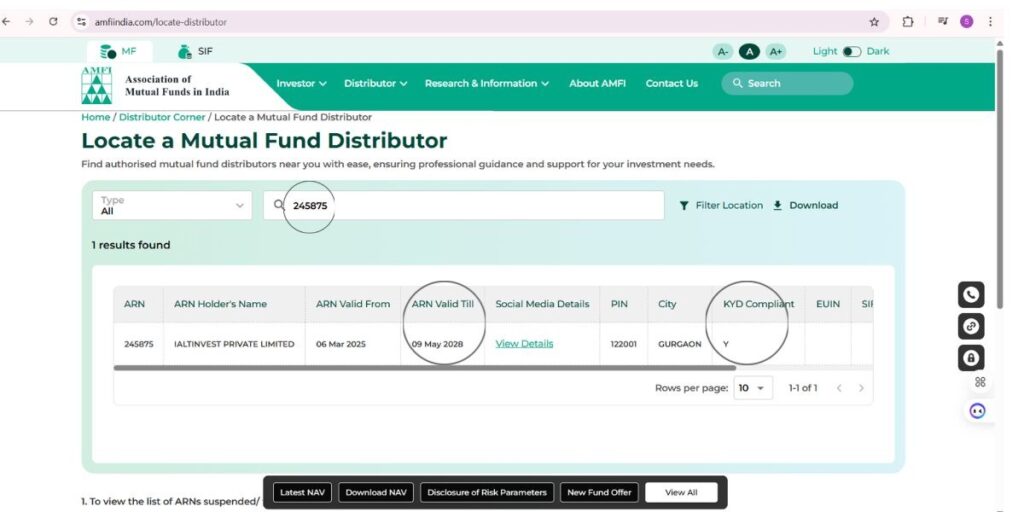
By searching using the distributor’s ARN or name, investors can check:
- Registration status
- Certification validity
- Distributor type (individual or corporate)
- Location and basic details
This step helps confirm whether the distributor is currently authorised to operate.
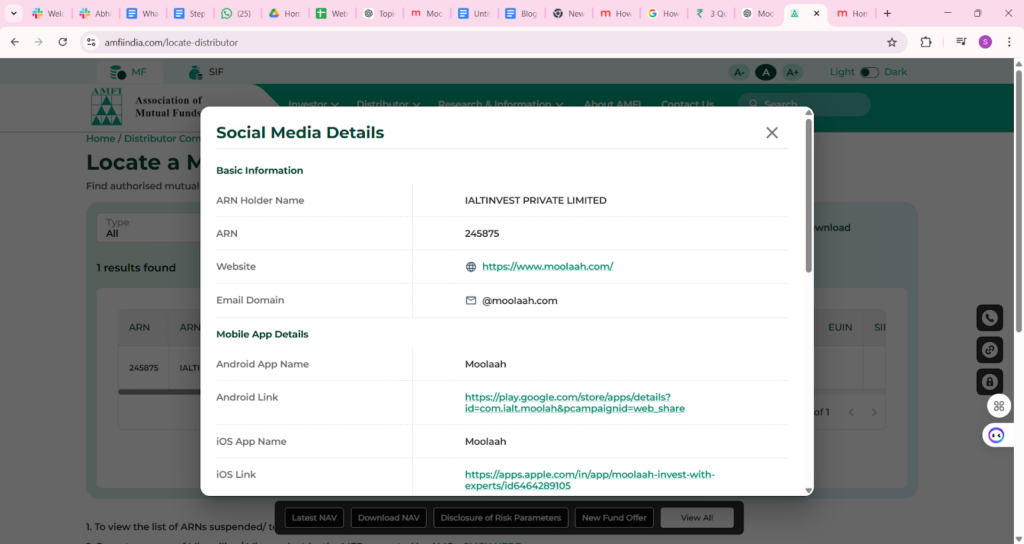
You can also verify the social media handles of the distributor by checking the social media details available in the listing.
Step 2: Verify NISM certification validity
To obtain and maintain an ARN, distributors must clear the NISM Series V-A: Mutual Fund Distributors Certification Examination. This exam ensures that distributors understand:
- Mutual fund products and structures
- Investor suitability and risk disclosure
- Regulatory requirements and ethical practices
This certification has a validity period and must be renewed at regular intervals. An expired certification means the distributor is not authorised to handle mutual fund investments.
You can ask the distributor for NISM certification details. However, if you have already verified the ARN, this step is not mandatory, as only NISM-certified distributors are issued an ARN.
Step 3: Check EUIN for corporate distributors
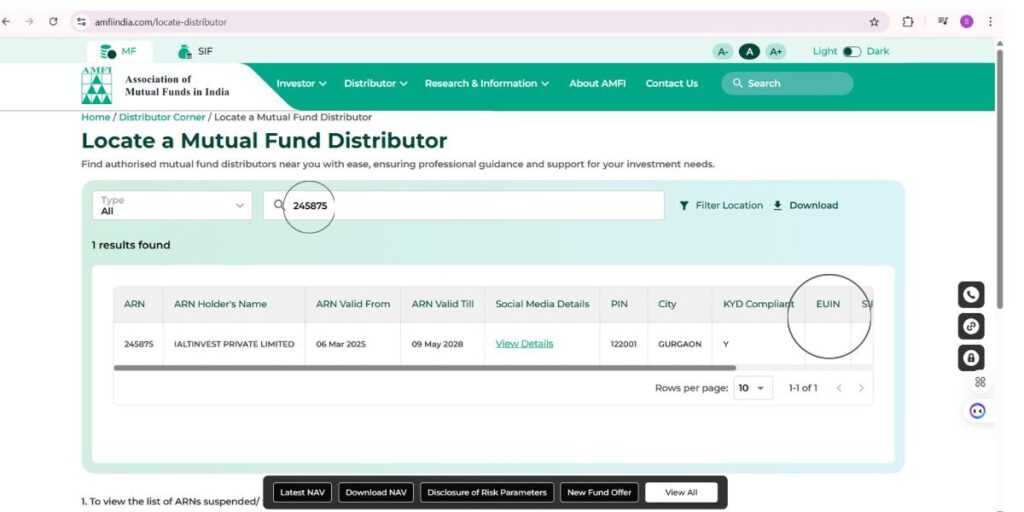
If you are dealing with a corporate mutual fund distributor, ask for the EUIN (Employee Unique Identification Number) of the individual advisor handling your account.
The EUIN identifies the specific person providing advice or guidance. This ensures accountability at the individual level, even when the distributor operates under a larger corporate entity.
You can verify the EUIN using the same “Locate Your Distributor” section on the AMFI website.
Step 4: Assess experience and conduct beyond registration
Registration and certification confirm eligibility—but experience and conduct determine quality.
Investors should assess:
- How long the distributor has been active
- Whether they follow a structured process (KYC, goal discussion, risk profiling)
- Whether recommendations are explained clearly and documented
- Whether commissions and plan types are disclosed transparently
A registered distributor who pushes products without understanding goals or risk tolerance should still be approached with caution.
To understand more about the factors involved in choosing a suitable distributor – read How to Choose the Right Mutual Fund Distributor for Your Investment Goals.
Step 5: Reduce effort by using verified platforms
While investors can verify each detail manually, platforms like Moolaah simplify this by listing verified mutual fund distributors whose registration and certification status have already been checked. Distributor profiles also highlight experience and areas of expertise, making comparison easier without relying solely on claims.
This helps investors focus more on evaluating suitability rather than chasing basic verification details.
Additionally, transactions are executed securely through the Moolaah platform, ensuring proper documentation, transparency, and traceability—rather than being handled through informal or external channels.
Common red flags to watch out for
Even after basic verification, certain warning signs can indicate poor practices or higher risk. Investors should remain cautious if a distributor:
- Is unable or unwilling to share a valid ARN or EUIN
- Avoids clearly explaining commissions, plan types, or associated costs
- Makes claims of guaranteed or assured returns
- Suggests investments without understanding financial goals, time horizon, or risk tolerance
Registration confirms eligibility, but it does not replace ethical conduct, transparency, and a structured advisory approach. Paying attention to these red flags can help investors avoid unsuitable or misaligned guidance.
For investors who prefer to begin with added clarity, starting with a verified list can simplify the initial screening process.
View Verified Mutual Fund Distributors on Moolaah
For a clear, step-by-step guide to investing through a mutual fund distributor, read Step-by-Step Process to Start Investing with a Mutual Fund Distributor.
FAQs
How can I check if my mutual fund distributor is AMFI registered?
You can check whether a distributor is AMFI registered by verifying their AMFI Registration Number (ARN). A valid ARN confirms that the distributor is authorised to distribute mutual fund schemes in India and operates under regulatory oversight.
Is NISM certification mandatory for all mutual fund distributors?
Yes. Clearing the NISM Series V-A Mutual Fund Distributors Certification Examination is mandatory to obtain and maintain an ARN. Without a valid NISM certification, a distributor is not authorised to handle mutual fund investments.
What is the difference between ARN and EUIN?
ARN identifies the registered mutual fund distributor or firm, while EUIN (Employee Unique Identification Number) identifies the individual advisor handling your account in the case of a corporate distributor. EUIN helps ensure individual-level accountability.
Can I invest if a distributor’s certification has expired?
No. If a distributor’s NISM certification has expired, they are not authorised to distribute mutual funds until the certification is renewed. Investors should avoid transacting during this period.
Does AMFI registration guarantee that a distributor will give good advice?
AMFI registration confirms eligibility and compliance, but it does not guarantee quality of advice. Investors should also assess the distributor’s experience, transparency, communication style, and whether they follow a structured investment process.
How can platforms like Moolaah help with distributor verification?
Platforms like Moolaah simplify the verification process by listing distributors whose registration and certification status have already been checked. Distributor profiles also highlight experience and expertise, helping investors evaluate options more efficiently.
Disclaimer – Moolaah is an AMFI-registered Mutual Fund Distributor (ARN-245875). We distribute Regular Plans of Mutual Fund schemes, which involve the payment of trail commission to us. Our services are incidental to product distribution and do not constitute independent investment advice. Mutual Fund investments are subject to market risks, read all scheme related documents carefully.


