

Table of Contents
Starting your mutual fund journey with a trusted distributor doesn’t just simplify the process it also helps you sidestep guesswork and headaches.
But even with top-tier guidance, one thing remains constant: you’ll still need a few essential documents in place before you can start investing.
Many first-time investors wonder if investing through a mutual fund distributor means extra paperwork or different documents compared to when you’re investing directly.
The simple answer? The documents remain the same.
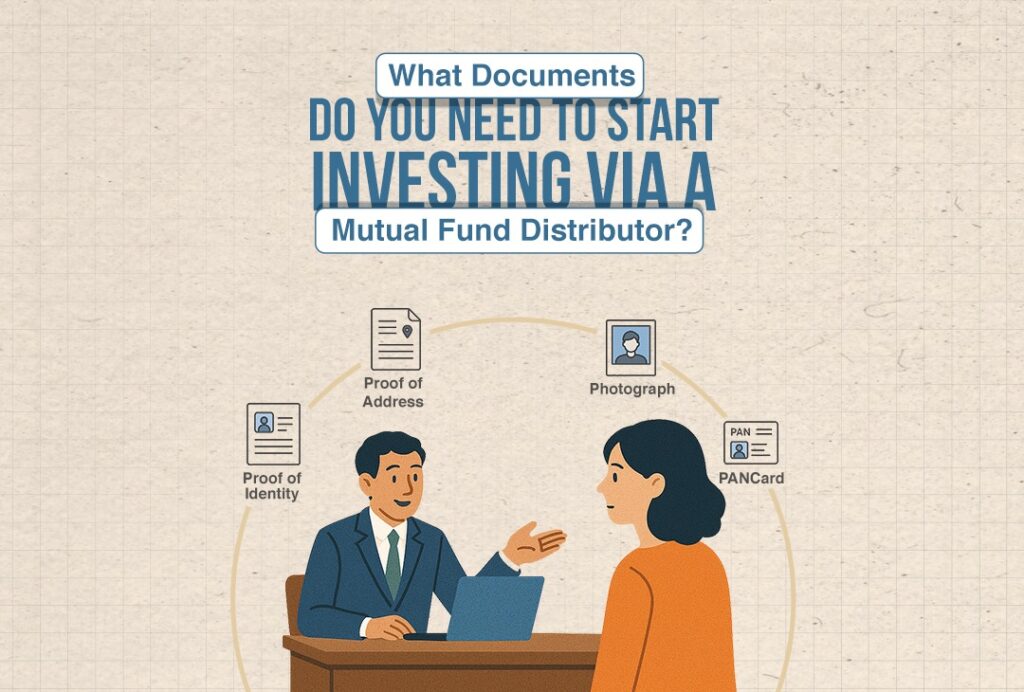
List of Documents Needed to Start Investing
Your PAN (Permanent Account Number) card is essential for investing in India. It connects your investments to your tax records and allows regulators to monitor your transactions.
However, if you’re making micro-investments (up to ₹50,000 per financial year), PAN isn’t mandatory – provided you furnish other valid ID proofs. Also, make sure your PAN is linked with Aadhaar as per regulatory requirements.
You’ll need to provide one valid ID proof that includes your photo and is issued by the central or state government. Commonly accepted documents include:
Investors are expected to submit any valid document to confirm their current address. Any one of the following documents can be submitted as valid proof:
A functional bank account is necessary for executing mutual fund transactions like SIPs, redemptions, and dividend payouts. The following documents are generally accepted:
Under the Foreign Account Tax Compliance Act (FATCA), investors are required to declare their country of tax residence, whether in India or abroad.
Even if you are an Indian resident, you must confirm your tax residency status and provide:
If the nominee is a minor, you’ll also need to provide:
In case the units are held jointly, all unit holders must jointly nominate a single person. The nominee will receive the rights to the units only if all joint holders pass away.
If you’re making investments on behalf of a minor (under age 18), the following documents are necessary:
Non-Resident Indians (NRIs) can invest in Indian mutual funds, subject to a few additional documentation requirements:
Entities like companies and trusts must submit specific organizational documents to invest:
KYC: What It Means and Why It Matters
KYC (Know Your Customer) is a mandatory process before you can invest in mutual funds.It’s a SEBI-mandated process to verify your identity and address- primarily to prevent misuse like fraud or money laundering.
Whether you’re investing directly or through a mutual fund distributor (MFD), completing your KYC is essential. You can do this through any of the three modes explained below.
Your MFD will help you fill out the KYC form and submit it, along with your self-attested documents, to a Common Service Centre (CSC) linked to a KYC Registration Agency (KRA) such as
CSCs (Common Service Centres) are access points that provide a range of digital services including e-governance, education, healthcare, entertainment, and other government or private services, especially in rural and remote areas.
Many MFDs now offer a fully online KYC process. Your distributor will guide you through the KRA’s online portal. You’ll need to:
Some MFDs and investment platforms also provide Aadhaar OTP-based eKYC. Just fill in the form, enter your Aadhaar details, and verify using the OTP sent to your linked mobile number. Your Aadhaar information will authenticate your identity in minutes.
This method comes with a cap – allowing investments of up to ₹50,000 annually per mutual fund house. If you want to invest more, you’ll need to go through an in-person verification (IPV).
How to Submit Each Document in Different KYC Modes
| Document | Offline KYC | Online KYC | Aadhaar-based eKYC |
| PAN Card | Self-attested photocopy + Original for verification | Scanned copy upload (PDF/JPEG) | Auto-fetched via Aadhaar if linked; else not required for micro-investments |
| Proof of Identity (POI) | Self-attested photocopy + Original for verification | Scanned copy upload | Verified via Aadhaar details |
| Proof of Address (POA) | Self-attested photocopy + Original for verification | Scanned copy upload | Aadhaar serves as POA |
| Bank Details (e.g. cheque/passbook) | Self-attested copy + Original if required | Scanned copy upload (cancelled cheque or statement) | May be fetched from Aadhaar-linked bank (not always) |
| Photographs | 1–2 Passport-sized photos (physical) | Digital photo upload | Not separately required (photo fetched from Aadhaar) |
| FATCA Declaration | Physical form signed by investor | Online form submission | Usually required separately |
| Nominee Details | Filled in nominee section of form + self-attested ID | Input online in KYC form | Input online or linked through Aadhaar OTP-based form |
| Minor/Guardian Documents | Self-attested copies + originals for verification | Scanned upload of all minor and guardian-related proofs | Aadhaar can be used for minor & guardian where applicable |
This method comes with a cap – allowing investments of up to ₹50,000 annually per mutual fund house. If you want to invest more, you’ll need to go through an in-person verification (IPV).
Practical Checklist Before Meeting Your MFD
Find a Certified MFD and Start Investing
Now you know exactly what documents you’ll need to start investing with a mutual fund distributor.
The next step is finding someone you trust.
When you have the right MFD by your side, you don’t have to figure out the paperwork and KYC alone. You get clear, step-by-step help to get it done right, without all the back-and-forth and stress.
And that’s where Moolaah comes in.
With so many investment scams out there today, it’s more important than ever to choose a verified, reliable MFD before you begin your mutual fund journey.
At Moolaah, we make that easy. Choose from a wide network of AMFI-registered Mutual Fund Distributors (MFDs), explore verified profiles, check their experience, and pick the one that best fits your investment needs.
Your distributor will help you handle the forms, submit the documents, and guide you through every step – so you can start investing smoothly and confidently.
Note: If you’re investing online through a distributor, you’ll need to go through the KYC process and submit all required documents once. Once verified, the distributor can execute all your mutual fund investments across different fund houses via a single platform.
However, if you choose to work with another distributor whose platform is different, you may have to undergo the same KYC and documentation process again.
Mutual Funds
Direct Vs Regular Mutual Funds Which One Suits You Best?
Mutual Funds
Can You Switch Your Mutual Fund Distributor? Process and Precautions
Mutual Funds
Mutual Funds Decoded: A Comprehensive Guide
Moolaah is an independent wealthtech ecosystem, with the aim of delivering a better financial future to individuals and families with the help of Moolaah Partners. The brand is owned by iAltinvest Private Ltd (ARN – 245875).
Mutual Fund investments are subject to market risks, read all scheme-related documents carefully before investing. Historical performance is not indicative of future performance.
Connect With Us
Copyright © 2026 Moolaah
Moolaah is an independent wealthtech ecosystem, with the aim of delivering a better financial future to individuals and families with the help of expert advisors.